In Short
Buying a foreclosed home in NYC requires five steps: (1) identify foreclosure type — pre-foreclosure, judicial auction, or REO; (2) secure financing pre-approval, including renovation reserves; (3) inspect the property and verify clear title; (4) bid at the courthouse auction or negotiate directly with the bank; (5) close, addressing redemption rights and hidden liens. The full process typically takes 60-180 days from offer to keys.
Executive Summary
- Three types of foreclosure in NYC — pre-foreclosure (homeowner still owns), judicial auction (court-supervised sale), and REO (bank-owned post-foreclosure). Each requires a different acquisition strategy.
- NYC follows a judicial foreclosure process — every foreclosure goes through the court system, averaging 1,000+ days from default notice to foreclosure sale. This creates predictable deal timelines but limits surprise inventory.
- Title risk is the #1 reason foreclosure deals fail — junior liens, mechanics' liens, unpaid HOA dues, and tax liens can survive the foreclosure sale. Always order a full title search before bidding.
- NYC co-op foreclosures require board approval just like any co-op resale — bidders cannot assume approval. Condo and townhouse foreclosures bypass board review.
- Auction bidding requires certified funds — typically 10% deposit at auction, balance due in 30 days. Cash buyers and pre-approved investors dominate the courthouse market.
Step 1 — Understand the Three Types of NYC Foreclosure
Not all "foreclosed homes" trade the same way. Before you bid on anything, identify which stage you're dealing with.
Pre-Foreclosure (Lis Pendens Filed)
The owner has missed payments and the lender has filed a Notice of Pendency (lis pendens) with the New York County Clerk. The owner still holds title and can sell directly. These are short-sale opportunities — typically requiring lender approval at a discount to the loan balance. Best for buyers willing to negotiate with the homeowner and wait 90-180 days for short-sale approval.
Judicial Auction (Sheriff's Sale)
If the homeowner doesn't cure the default or sell, the property proceeds to a court-ordered auction at the county courthouse. NYC auctions run weekly — Manhattan's are held at 60 Centre Street. Properties sell to the highest qualified bidder. The lender typically opens bidding at the loan balance, meaning auction prices often exceed market value when the loan is current with arrears. Best for cash buyers comfortable with limited inspection access.
REO (Bank-Owned, Post-Auction)
When no qualified bidder meets the lender's reserve, the property reverts to the bank as REO (Real Estate Owned). The bank lists it through a broker on the open market — typically at a discount. REO acquisitions are the closest to a traditional purchase: title is clearer (the bank has cured most liens), inspections are permitted, and standard mortgage financing works. Best for buyers seeking foreclosure pricing without auction risk.
Step 2 — Secure Financing Before You Bid
Foreclosure deals fail more often on financing than on price. Three rules:
- Auction bidding requires certified funds. A 10% deposit (cashier's check or wire) is due at the courthouse, with balance due in 30 days. Mortgage contingencies are not accepted.
- Renovation reserves matter. Foreclosed homes often need 5-15% of purchase price in deferred maintenance. Financing the property at 80% LTV without reserves is the most common reason new buyers go upside-down.
- NYC co-op foreclosures need board approval. Even a winning bidder must pass financial review by the building's co-op board. Failed approvals require the lender to remarket the unit.
For REO purchases, FHA 203(k) and Fannie Mae HomeStyle loans roll renovation costs into the mortgage and are commonly used by first-time foreclosure buyers.
Step 3 — Inspect the Property and Verify Title
The single biggest source of post-closing loss in NYC foreclosures is title risk. Before you commit:
- Order a full title search from a NY title insurance company. Look for junior mortgages, mechanics' liens, ConEd / National Grid utility liens, NYC water-and-sewer liens, HPD violations, and HOA past-due assessments.
- Check the certificate of occupancy on the NYC Department of Buildings website. Foreclosed properties frequently have illegal SROs, illegal basement units, or open work-without-permit violations that survive the sale.
- For condos and co-ops, check the building's financials — buildings in financial distress may have special assessments pending that survive the foreclosure sale and become the new owner's responsibility.
- For Manhattan and Brooklyn 1-4 family townhouses, order a structural inspection and a Phase 1 environmental review for older properties (lead, asbestos, oil tank).
Step 4 — Bid at Auction or Negotiate the REO
The bidding strategy depends on which foreclosure type you're pursuing.
At the courthouse auction: Arrive early. Register with the auctioneer. Bring a 10% deposit in cashier's checks (split into multiple checks if you plan to bid on multiple properties). The lender's representative will open bidding at the loan balance. Bidders who exceed the lender's reserve win the property as-is, with no inspection contingency.
For REO purchases: Banks typically reject offers below 90% of list price in the first 30 days. After 60 days on market, REO discount opens to 75-80% of list. Submit offers with proof of funds, no inspection contingency, and a 30-day close.
Step 5 — Close, and Address Redemption Rights
Closing on a NYC foreclosure differs from a standard purchase in three ways:
- NYC has no statutory right of redemption after a judicial foreclosure sale — once the auction closes, the previous owner cannot reclaim the property by paying off the debt.
- Eviction of holdover occupants is the buyer's responsibility. NYC's tenant-protection laws apply to foreclosed rental units — existing leases must be honored until expiration.
- Cash for keys negotiations are common with former owners still in possession. Budget $5,000-$15,000 to relocate former occupants without litigation.
Foreclosure vs. Standard NYC Purchase: Side-by-Side
Comparison: Foreclosure vs. Traditional Purchase
| Factor | Foreclosure | Standard Purchase |
|---|---|---|
| Pricing | Discount to market (5-25%) | Market value |
| Inspection | Limited (auction) or full (REO) | Full pre-contract |
| Title risk | High — survey + title insurance critical | Standard |
| Financing | Cash at auction; standard for REO | Standard mortgage |
| Closing speed | 30-60 days (REO); 30 days (auction) | 60-90 days |
| Co-op approval | Required, may delay 60-90 days | Required |
| Renovation reserves | 5-15% of purchase price typical | Buyer discretion |
| Possession | May require eviction of occupants | Vacant at closing |
Frequently Asked Questions — NYC Foreclosure Buying
Frequently Asked Questions
How long does it take to buy a foreclosed home in NYC?
Can I get a mortgage on a foreclosed home in NYC?
Are NYC foreclosures really discounted?
What's the difference between a short sale and a foreclosure in NYC?
Can the previous owner reclaim a foreclosed property in NYC?
What happens to the existing tenants in a foreclosed NYC rental?
Are co-op foreclosures different from condo foreclosures in NYC?
How do I find foreclosure listings in NYC?
Manhattan Condo Market
Pricing trends, inventory, days-on-market.
InventoryLatest NYC Co-ops
Recent-to-market listings.
Tax StrategyNYC Tax Abatements
421-a buildings still active through 2045.
AdvisorySpeak to a Buyer's Agent
Confidential, no-obligation consultation.
When you're ready
Begin with a conversation, not a listing.
Manhattan Miami advises buyers and sellers across both markets. We start by understanding your goals — then we curate the right buildings, neighborhoods, and timing.
Start the Conversation
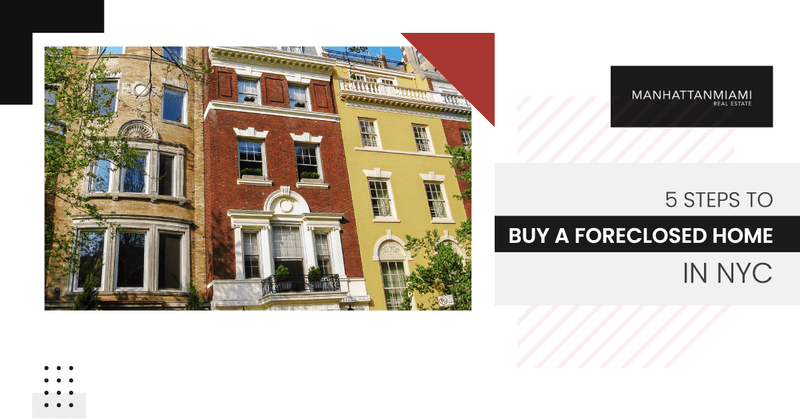
Buying a foreclosure in NYC is one of the best ways to buy a home because they can sell at a great price. Buying a foreclosed home can come with a few extra tricky spots along the road. For one, you'll have to buy the home in "as-is" condition, which means that you might get a house that has some major problems that you have to fix before it's livable. In general, though, a lot of the process is fairly similar to buying a regular house. These are the steps that you should take to buy a foreclosure.
1. Get Your Real Estate Agent
When you want to buy a house, one of the first steps that you'll take is hiring a real estate agent to sidestep the frustrations and confusions that come with buying your home on your own. The right real estate agent can help you identify foreclosure properties that match your criteria, and you'll learn about them sooner, which will help you compete with the investor competition.
2. Get a Pre-Approval Letter On a Loan
Just like when you buy a regular home, you should get a pre-approval on a loan to show that you're in the position to finance this purchase. A pre-approval loan will show how much you can borrow, too. Because your foreclosure will likely need some work, think about getting an FHA 203(K). This type of loan is perfect when you need lots of repairs because you can often allocate up to $35,000 for renovations.
3. Analyze Your Options
You want to get the best home available for your budget and what's available in the area. To do this, work with your agent to run a comparative market analysis, which will look at factors such as square footage, location, the volume of current home sales, and tax history. Doing this step will also help you determine how much to offer, which can put you in a better position to make an offer that can compete with cash offers.
4. Make a Competitive Offer
When other foreclosures are selling quickly, you'll have to bid higher because banks that own the foreclosed properties know that they'll get their asking price quickly. Banks don't want to hold onto foreclosed properties for long because it ties up their money, so going in with a slightly higher offer can entice them to take your quick and slightly higher bid even though you can't pay cash because it lets them move on. Plus, bidding low is a bad idea because most foreclosures are already greatly discounted compared to fair market value.
5. You'll Be Buying As-Is Condition
Renovation costs in New York can be tens of thousands of dollars. You never know how poor of condition that house is in, so sometimes foreclosures are best left to experienced buyers.
When you're looking for homes for sale in NYC, you can find some great options when you talk to the right real estate agent. Foreclosures in NYC can be tricky to purchase, and having someone with experience on your side can be the difference between getting a home you'll love and ending up in a situation that hurts you more than it helps.
NYC Foreclosure Timeline by Acquisition Type
Curated by Manhattan Miami · 2026 data
Average Days from Offer to Keys (NYC, 2025-2026)
| Acquisition Type | Timeline | Financing | Buyer Suitability |
|---|---|---|---|
| REO (bank-owned) | 30-60 days | Standard mortgage OK | Highest — clean process |
| Pre-foreclosure / short sale | 90-180 days | Mortgage OK; lender approval required | Medium — lender delays |
| Courthouse auction | 30 days post-bid | Cash only at auction | Lower — limited inspection |
| Co-op foreclosure (UCC sale) | 60-180 days | Cash + co-op board approval | Medium — board approval risk |
Active inventory: NYC new developments, luxury condos NYC, Miami new developments, Miami pre-construction.